
Understanding Acquired Hypothalamic Obesity
Share this post

Sponsored Content: This blog post was sponsored and submitted by Rhythm Pharmaceuticals
When the Hypothalamus Is Injured: Understanding Acquired Hypothalamic Obesity and Why Early Recognition Matters
The hypothalamus may be small, but its influence on human physiology is profound. As a central regulator of neuroendocrine function, it plays a critical role in maintaining homeostasis—coordinating hunger and satiety, energy expenditure, sleep–wake cycles, thermoregulation, thirst, and fatigue.1-4 When this finely tuned system is disrupted, the downstream clinical consequences can be severe and lifelong.
One such consequence is Acquired Hypothalamic Obesity (Acquired HO)—a rare but devastating condition that is fundamentally different from more common forms of obesity and often misunderstood or underrecognized in clinical practice.
The Hypothalamus and Energy Homeostasis: Role of MC4R Pathway
Energy balance is not simply a matter of “calories in versus calories out.” It is a tightly regulated biological process orchestrated by the hypothalamus, which integrates peripheral signals of hunger and satiety to modulate food intake and energy expenditure.5,6
At the center of this regulation is the melanocortin 4 receptor (MC4R) pathway. Within the hypothalamus, this pathway plays a pivotal role in signaling satiety and regulating energy expenditure. Disruption of MC4R signaling—whether congenital or acquired—can profoundly alter appetite control and metabolic balance.7,8
How Hypothalamic Injury Disrupts the MC4R Pathway
In Acquired HO, injury to the hypothalamus reduces production of α‑melanocyte‑stimulating hormone (α‑MSH) and impairs downstream activation of the MC4R pathway.7,8 The result is a biologic state characterized by:9-11
- Pathological hyperphagia (definition below)
- Reduced energy expenditure
- Accelerated and sustained weight gain
This weight gain is not simply behavioral or lifestyle‑driven—it is the direct consequence of disrupted central energy regulation which makes it resistant to behavioral interventions such as caloric restrictions and increasing physical activity.
What Makes Acquired Hypothalamic Obesity Distinct?
Acquired HO is a clinical diagnosis, most often emerging within months following hypothalamic injury, though onset and progression can vary depending on the extent and location of damage.12
Common causes of hypothalamic injury:13-15
- Hypothalamic‑pituitary tumors (e.g., craniopharyngioma, astrocytoma, pituitary macroadenomas)
- Tumor treatment (surgical resection, radiation)
- Traumatic brain injury
- Stroke
- Inflammatory conditions affecting the hypothalamus
Importantly, Acquired HO can develop in both children and adults.
Three features help distinguish Acquired HO from other forms of obesity:
- A clear hypothalamic insult followed by accelerated or sustained weight gain12
- Presence of one or more central hormone deficiencies due to hypothalamic–pituitary dysfunction16
- Persistent weight gain that continues despite appropriate hormone replacement, caloric restriction, and exercise13-15
These patients often experience obesity that is resistant to conventional weight‑management strategies, underscoring the need for early recognition, appropriate treatment and specialized care.
The Human Burden: More Than Weight Gain
Acquired HO is severe, progressive, and associated with substantial morbidity. Patients face increased risks of metabolic dysfunction-associated fatty liver disease (MAFLD), dyslipidemia, hypertension, and cardiovascular disease—but the impact extends far beyond metabolic complications.
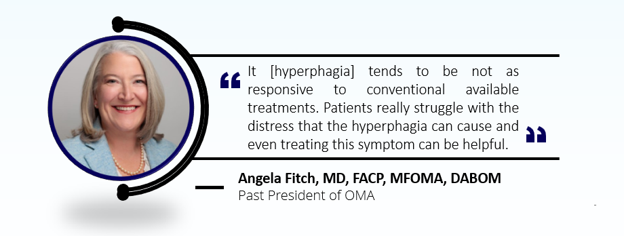
Increased hunger and hyperphagia are reported in approximately 72% of individuals with Acquired HO, manifesting as chronic, insatiable hunger with impaired satiety.17 Unlike typical overeating, hyperphagia is severe, persistent, and often accompanied by distressing food‑seeking behaviors. In children, this may include tantrums or persistent negotiation for food; in adults, emotional distress and loss of control. In severe cases, patients may hide, steal, or consume discarded food.18,19
Caregivers feel this burden acutely. In surveys of caregivers of craniopharyngioma survivors, prevention and management of hypothalamic obesity consistently rank among their highest unmet needs, with hyperphagia strongly associated with higher caregiver burden scores.17
Recognizing Acquired Hypothalamic Obesity Early
Early identification is critical. Clinicians should maintain a high index of suspicion in patients with a history of hypothalamic injury. Acquired HO requires two key markers – a hypothalamic-pituitary injury and weight gain following the hypothalamic-pituitary injury. 15,20,21
Manifestations of hypothalamic dysfunction due to injury may include:21,22
- Presence of Central Hormone Deficiencies
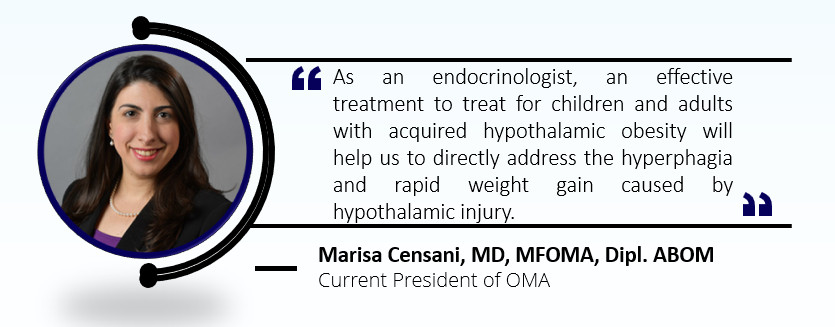
- Hyperphagia
- Temperature Dysregulation
- Fatigue, sleep disorders or lower physical activity
Although patients with hypothalamic-pituitary tumors commonly have mild and transient weight gain due to titrations of hormones and/or steroid therapy (usually within the first 3 months) – the weight gain due to acquired HO is sustained beyond this transient weight gain and accelerates quickly. 20,23,24 It is very distinct from general obesity and patients with prior brain injury may present with obesity that remains refractory to standard interventions—making longitudinal follow‑up essential.
A Call to Proactive Monitoring and Screening
For clinicians caring for patients with:
- Hypothalamic‑pituitary tumors or tumor treatment
- Traumatic brain injury
- Stroke
- Other causes of hypothalamic injury
Proactive monitoring for Acquired HO is strongly recommended.1,25 Early recognition creates opportunities for timely intervention, multidisciplinary care, and more informed discussions with patients and caregivers about expectations and long‑term management.
Learn More
If you are a U.S.-based healthcare professional interested in rare neuroendocrine diseases affecting the MC4R pathway, follow Rhythm Medical Affairs on LinkedIn for ongoing scientific education and updates.
MOMENTUM – MC4R Pathway Summit
If you are interested in learning more about obesity associated with MC4R Pathway Diseases, join us at inaugural MOMENTUM, MC4R Pathway Summit on Friday, June 12 in Chicago, ahead of The Endocrine Society’s Annual Meeting (ENDO). This summit is sponsored by Rhythm and is not affiliated with ENDO. For more information on MOMENTUM, please email: MC4Rsummit@rhythmtx.com.
Article written by:

-
1. van Santen HM, van Schaik J, van Roessel I, Beckhaus J, Boekhoff S, Müller HL. Diagnostic criteria for the hypothalamic syndrome in childhood. Eur J Endocrinol. Feb 14 2023;188(2)doi:10.1093/ejendo/lvad009
2. Sheng JA, Bales NJ, Myers SA, et al. The Hypothalamic-Pituitary-Adrenal Axis: Development, Programming Actions of Hormones, and Maternal-Fetal Interactions. Front Behav Neurosci. 2020;14:601939. doi:10.3389/fnbeh.2020.601939
3. Shahid Z, Asuka E, Sing G. Physiology, Hypothalamus. StatPearls [Internet]. StatPearls Publishing; 2023.
4. Waterson MJ, Horvath TL. Neuronal Regulation of Energy Homeostasis: Beyond the Hypothalamus and Feeding. Cell Metab. Dec 1 2015;22(6):962-70. doi:10.1016/j.cmet.2015.09.026
5. Timper K, Bruning JC. Hypothalamic circuits regulating appetite and energy homeostasis: pathways to obesity. Dis Model Mech. Jun 1 2017;10(6):679-689. doi:10.1242/dmm.026609
6. Affinati AH, Myers MG. Neuroendocrine Control of Body Energy Homeostasis. Endotext [Internet]. MDText.come, Inc.; 2021.
7. da Fonseca ACP, Mastronardi C, Johar A, Arcos-Burgos M, Paz-Filho G. Genetics of non-syndromic childhood obesity and the use of high-throughput DNA sequencing technologies. J Diabetes Complications. Oct 2017;31(10):1549-1561. doi:10.1016/j.jdiacomp.2017.04.026
8. Huvenne H, Dubern B, Clément K, Poitou C. Rare Genetic Forms of Obesity: Clinical Approach and Current Treatments in 2016. Obes Facts. 2016;9(3):158-73. doi:10.1159/000445061
9. Abuzzahab MJ, Roth CL, Shoemaker AH. Hypothalamic Obesity: Prologue and Promise. Horm Res Paediatr. 2019;91(2):128-136. doi:10.1159/000496564
10. Roth CL, Enriori PJ, Gebhardt U, et al. Changes of peripheral alpha-melanocyte-stimulating hormone in childhood obesity. Metabolism. Feb 2010;59(2):186-94. doi:10.1016/j.metabol.2009.06.031
11. Roth CL, Blevins JE, Ralston M, et al. A novel rodent model that mimics the metabolic sequelae of obese craniopharyngioma patients. Pediatr Res. Mar 2011;69(3):230-6. doi:10.1203/PDR.0b013e3182083b67
12. Dimitri P. Treatment of Acquired Hypothalamic Obesity: Now and the Future. Front Endocrinol (Lausanne). 2022;13:846880. doi:10.3389/fendo.2022.846880
13. Roth CL, Eslamy H, Werny D, et al. Semiquantitative analysis of hypothalamic damage on MRI predicts risk for hypothalamic obesity. Obesity (Silver Spring). Jun 2015;23(6):1226-33. doi:10.1002/oby.21067
14. Witte J, Surmann B, Batram M, et al. Hypothalamic obesity: Epidemiology in rare sellar/suprasellar tumors-A German claims database analysis. J Neuroendocrinol. Dec 2024;36(12):e13439. doi:10.1111/jne.13439
15. Bereket A. Postoperative and Long-Term Endocrinologic Complications of Craniopharyngioma. Horm Res Paediatr. 2020;93(9-10):497-509. doi:10.1159/000515347
16. Rose SR, Horne VE, Bingham N, Jenkins T, Black J, Inge T. Hypothalamic Obesity: 4 Years of the International Registry of Hypothalamic Obesity Disorders. Obesity (Silver Spring). Nov 2018;26(11):1727-1732. doi:10.1002/oby.22315
17. Kayadjanian N, Hsu EA, Wood AM, Carson DS. Caregiver Burden and Its Relationship to Health-Related Quality of Life in Craniopharyngioma Survivors. J Clin Endocrinol Metab. Dec 21 2023;109(1):e76-e87. doi:10.1210/clinem/dgad488
18. Heymsfield SB, Avena NM, Baier L, et al. Hyperphagia: current concepts and future directions proceedings of the 2nd international conference on hyperphagia. Obesity (Silver Spring). Feb 2014;22 Suppl 1(0 1):S1-S17. doi:10.1002/oby.20646
19. Dykens EM, Maxwell MA, Pantino E, Kossler R, Roof E. Assessment of hyperphagia in Prader-Willi syndrome. Obesity (Silver Spring). Jul 2007;15(7):1816-26. doi:10.1038/oby.2007.216
20. Roth CL, McCormack SE. Acquired hypothalamic obesity: A clinical overview and update. Diabetes Obes Metab. Apr 2024;26 Suppl 2:34-45. doi:10.1111/dom.15530
21. Shoemaker AH, Tamaroff J. Approach to the Patient With Hypothalamic Obesity. J Clin Endocrinol Metab. Apr 13 2023;108(5):1236-1242. doi:10.1210/clinem/dgac678
22. van Santen HM. The Central Control of Energy Metabolism: Hypothalamic Obesity Is Not One Disease. Horm Res Paediatr. 2026;99(2):175-184. doi:10.1159/000543544
23. Hong AR, Kim JH, Park SS, et al. Determinants of Short-Term Weight Gain Following Surgical Treatment for Craniopharyngioma in Adults. J Korean Neurosurg Soc. May 2022;65(3):439-448. doi:10.3340/jkns.2021.0067
24. Fu XH, Xue XC, Zhou PZ, Yin SL, Jiang S. [Pituitary functional recovery and hormone replacement therapy of patients with pituitary adenoma surgery]. Sichuan Da Xue Xue Bao Yi Xue Ban. May 2013;44(3):448-51.
25. Roth CL. Hypothalamic Obesity in Craniopharyngioma Patients: Disturbed Energy Homeostasis Related to Extent of Hypothalamic Damage and Its Implication for Obesity Intervention. J Clin Med. Sep 9 2015;4(9):1774-97. doi:10.3390/jcm4091774