
OMA Updates from the November 2026 AMA Interim Meeting
Share this post
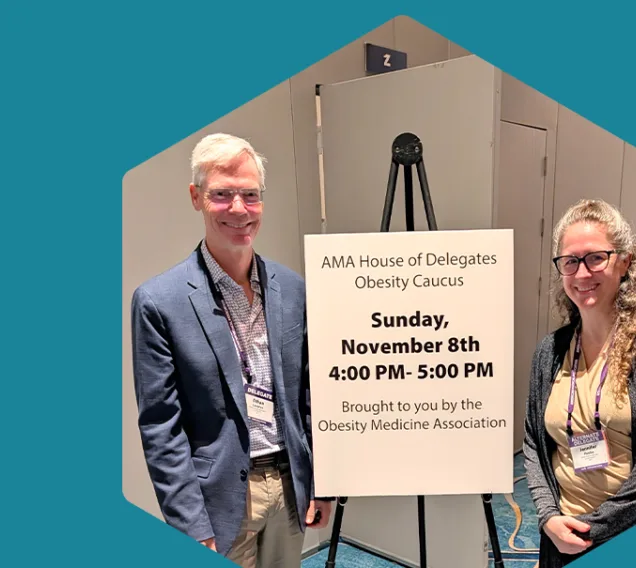
The November 2026 American Medical Association (AMA) Interim Meeting marked a successful milestone for the Obesity Medicine Association (OMA). In their report to the OMA Board of Trustees, Dr. Ethan Lazarus, OMA Delegate, and Dr. Jennifer Paisley, OMA Alternate Delegate to the AMA House of Delegates, highlighted two significant accomplishments: the successful adoption of another OMA-sponsored resolution and a productive meeting of the Obesity Caucus, an initiative established and led by the OMA. Both achievements reflect the OMA’s continued leadership in advancing obesity medicine and advocating for evidence-based care nationwide.
These accomplishments reinforce the OMA’s growing influence within organized medicine and our ongoing commitment to patient safety, evidence-based obesity care, and national advocacy.
Successful Passage of the OMA Resolution on Compounded Peptides
On October 28, 2026, the Department of Health and Human Services (HHS) issued a directive permitting 503A compounding pharmacies to produce six previously restricted synthetic peptides. These substances, often marketed for weight management, wellness, longevity, and anti-aging, lack sufficient scientific evidence supporting their safety and efficacy, raising serious concerns about patient safety and the continued practice of evidence-based medicine.
In response, OMA delegates submitted a resolution titled Urging Federal Action to Rescind Administrative Directives Permitting Unapproved Synthetic Peptides and Enforce Patient Safety. The resolution received overwhelming support in the Reference Committee and was subsequently adopted as written by the AMA House of Delegates.
The adopted resolution calls on the AMA to:
- Advocate for federal regulatory action: Urge HHS, the U.S. Food and Drug Administration (FDA), and relevant federal regulatory authorities to rescind policies that ease restrictions on the compounding and distribution of unapproved, non-FDA-reviewed synthetic peptides.
- Strengthen regulatory oversight and enforcement: Collaborate with federal agencies, state medical boards, and state boards of pharmacy to pursue enforcement actions against compounding pharmacies, direct-to-consumer telehealth platforms, and online dispensaries distributing unapproved synthetic peptide formulations lacking FDA regulatory review.
- Educate healthcare professionals and the public: Increase awareness of the potential safety risks, lack of demonstrated clinical efficacy, and insufficient FDA oversight associated with unapproved synthetic peptide compounds and multi-peptide combinations, commonly referred to as “stacks.”
This resolution builds upon existing AMA policy recommending that unapproved synthetic peptide products undergo FDA regulatory review, third-party testing, and demonstration of safety and efficacy through well-conducted clinical trials before marketing or clinical use.
The successful passage of this resolution represents another important advocacy achievement for the OMA. As the field of obesity medicine continues to evolve, it is essential that patient safety and scientific evidence remain at the forefront of treatment decisions.
The Obesity Caucus: Elevating Obesity as a National Public Health Priority
On November 8, OMA delegates hosted another successful meeting of the Obesity Caucus. This open forum brings together representatives from numerous medical specialty organizations, including the American Association of Clinical Endocrinology (AACE), the Endocrine Society, the American Society for Metabolic and Bariatric Surgery (ASMBS), the Society of American Gastrointestinal and Endoscopic Surgeons (SAGES), the American Academy of Family Physicians (AAFP), and the American College of Obstetricians and Gynecologists (ACOG), as well as members of the AMA Board of Trustees.
This meeting featured a particularly influential guest, Dr. John Armstrong, current Vice Speaker of the AMA House of Delegates and incoming Speaker in June 2027.
A longstanding advocate for initiatives promoting healthy weight, Dr. Armstrong helped launch Florida’s Healthiest Weight campaign in 2013, an initiative that was reinvigorated in 2025.
During an engaging discussion, Dr. Armstrong emphasized how closely the work of the Obesity Caucus aligns with the AMA’s renewed Strategic Plan, particularly its focus on public health and access to evidence-based care.
He underscored a fundamental challenge: meaningful progress in improving the nation’s health will be difficult without addressing the pervasive impact of excess weight and obesity. He advocated for a multifaceted approach, beginning with a broader reframing of the national conversation around achieving and maintaining a healthy weight.
Importantly, Dr. Armstrong suggested that while recognizing obesity as a chronic disease remains essential, our advocacy efforts may benefit from expanding beyond that framework to embrace a broader national objective: achieving the healthiest possible weight for all Americans. He emphasized that weight-related health challenges intersect with many of the leading causes of death in the United States and have profound implications for life expectancy, maternal health, and infant mortality.
Having a strong advocate at this level of AMA leadership, particularly alongside incoming AMA President Dr. Sandra Fryhofer, presents a significant opportunity to elevate obesity prevention and treatment within the AMA’s national priorities.
Looking Ahead: Advancing Obesity Medicine Through National Collaboration
Building on the momentum of the November Interim Meeting, OMA delegates look forward to collaborating with Dr. Armstrong and fellow members of the Obesity Caucus to explore new strategies for leveraging the AMA’s leadership, influence, and advocacy infrastructure.
Our objectives include:
- Advancing evidence-based obesity prevention and treatment;
- Broadening access to effective, comprehensive obesity care; and,
- Positioning healthy weight as a central component of the nation’s public health strategy.
The engagement of senior AMA leadership offers a particularly promising opportunity to move these efforts forward in the coming years.
Continuing the OMA’s Commitment to Advocacy
The accomplishments of the November 2026 AMA Interim Meeting reflect the OMA’s growing influence within the AMA House of Delegates and demonstrate the importance of our continued participation in organized medicine at the national level.
Through our representation within the AMA, the OMA and its delegates continue to ensure that the perspectives of obesity medicine clinicians and the needs of patients living with obesity are represented in national healthcare policy discussions. Together, we will continue to work together to advance the field of obesity medicine, protect patient safety, and improve access to evidence-based obesity care.