
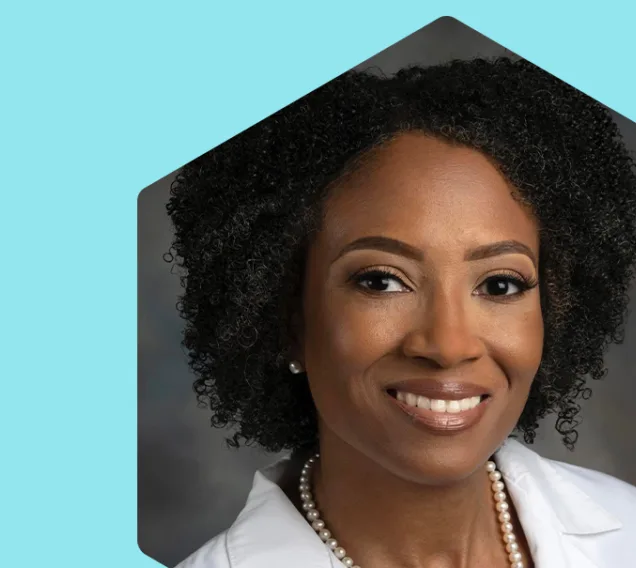
OMA Member Story: Tracy Norfleet, MD, MBA, DABOM, FACP
Share this post
Turning Experience into Advocacy
Growing up in the small town of Sunset, Louisiana, Tracy Norfleet, MD, MBA, DABOM, FACP, never imagined she would become a physician.
In fact, as a child, medicine wasn't even on her radar.
"Young Tracy wanted to be a dancer,” she laughed. “Young Tracy did not think about medicine at all.”
The only healthcare professional she knew of was her uncle, a pharmacist. She assumed she would follow in his footsteps.
“That’s all I knew, so I said, ‘Well, I’m going to be a pharmacist too.”
That changed during a summer program at Xavier University before her freshman year, led by pre-med students. After asking one of them what he planned to do after graduation, his answer motivated Dr. Norfleet.
"He said, 'I'm going to be a doctor.' And I said, 'I think I’m going to be a doctor too.'"
It was the first time she realized the possibility within the medical field.
Today, Dr. Norfleet is a triple board-certified physician in internal medicine, obesity medicine, and lifestyle medicine. She serves as a regional physician leader, caring for more than 2,000 patients while ensuring that policies and clinical strategies within her organization remain physician-led.
Outside of her clinical role, she is the founder of Weight Liberation (a health coaching and advocacy community), as well as a public speaker, TEDx presenter, and passionate advocate working to eliminate weight bias in healthcare.
"This is everything for me," she said. "This doesn't even feel like a job."
Turning Personal Experience into Purpose
Although Dr. Norfleet built her career in primary care, obesity medicine was personal before it became professional, as she had struggled with her weight for most of her life.
As a teenager, sports like basketball, softball, and cheerleading helped her stay active. After leaving for college, however, she began experiencing weight gain that would continue.
"I've gained and lost weight for the last 20 to 30 years."
She attempted everything from diets and commercial programs to running 5ks and half-marathons.
"I understood the struggle," she said. "I understood how hard it is not only to lose weight, but also to keep the weight off."
At the same time, she cared for patients with many of those same struggles.
Then one invitation changed everything. A colleague encouraged her to attend a local obesity medicine meeting in St. Louis. During the lecture, she learned about concepts she had never encountered during medical school or residency.
"I'm sitting there like, 'Oh my God. I didn't know this existed!"
She immediately began asking herself: "How can I be a primary care physician, knowing that every day I get questions about weight, and I do not know the science behind it? Not only for my patients—but for myself."
That curiosity led her to the Obesity Medicine Association. She became board-certified in obesity medicine and has attended every OMA conference since.
"I was like, 'These are my people.'"
Today, she helps patients understand what she once needed to hear herself: "It’s not just about willpower."
Beyond the Exam Room
For Dr. Norfleet, obesity care is about more than helping her patients within an office visit.
That mindset is why she created Weight Liberation. She realized there was only so much time to see each patient during a busy workday. She also knew many people left healthcare visits with unanswered questions.
"The climate of medicine now is we only have 15 minutes to talk to our patients," she said. "In reality, there's not much education that can be done in that time."
Dr. Norfleet created Weight Liberation to bridge that gap.
This community gives people a place to better understand their health, ask questions, and learn how to advocate for themselves during appointments. Weight Liberation also allows her to reach patients she may not be able to meet in person.
"I can't be your doctor," she tells them. "But I can give you the tools and skills so you can get the care you deserve."
Her motivation extends beyond education and access.
With only a small percentage of physicians in the United States being Black women, Dr. Norfleet understands how meaningful it can be for patients to see someone like them who shares and understands aspects of their lived experience. She uses that connection to build trust and encourage her patients to become active advocates for themselves.
Sharing the Message
Education has become one of Dr. Norfleet's greatest passions.
She regularly speaks at webinars and conferences, serves on community committees, and participates in Walk with a Doc, a program where physicians walk alongside community members while answering any health questions they might have.
One of her proudest accomplishments was delivering a TEDx Talk. Ironically, public speaking wasn't something that came naturally. She was comfortable presenting medical information to healthcare professionals, but sharing her own story required a different level of vulnerability.
"The process of letting Tracy show was very challenging," she said. "We're taught as clinicians to have a 'doctor presence.'"
Preparing for the talk forced her to set herself aside and focus on something bigger.
"The message isn't about me."
That philosophy continues to guide everything she does. Whether speaking to one patient or hundreds of clinicians, her goal of helping others better understand obesity as a chronic disease remains at the forefront.
Advocacy in Action
Dr. Norfleet's passion for educating patients and being an active member of her community naturally led her to advocacy.
As chair of the OMA's Advocacy Committee, she has become deeply involved in legislative efforts surrounding comprehensive obesity treatment, including the Treat and Reduce Obesity Act (TROA), the Bridge Act, and conversations with policymakers on Capitol Hill.
Serving in the role has given her a behind-the-scenes look at how policy directly affects patient care.
It has also taught her an important lesson: "When I was advocating on Capitol Hill, I realized many of the representatives just didn't understand what obesity was."
Helping the policymakers understand the science and the human stories behind the disease has become one of her greatest priorities.
She also became involved with the Obesity Action Coalition (OAC). Attending an OAC conference gave her something she rarely experienced elsewhere; she was surrounded not only by clinicians, but by patients as well.
"I loved the fact that community members and providers could come together in one room, all for the sake of advocating for equitable treatment of obesity."
Taking Down the White Coat
The greatest lesson Dr. Norfleet has learned throughout her career has nothing to do with medicine; it's about relationships.
Early in her career, she felt she needed to maintain distance from patients and keep up a certain image as a doctor. Over time, she realized that approach wasn't working. Taking down that professional wall between her and her patients made caring for them so much easier.
Today, authenticity is one of the most important tools she brings into every patient encounter.
"You can take the computer away. You can take the labs away. I just want to talk to my patients."
Rather than talking at patients, she focuses on talking with them.
She believes meaningful care begins by understanding who patients are, what challenges they face, and what they hope to achieve.
"You can't give advice to someone if you don't know where they’re coming from or what their needs are."
Looking Ahead
Whether she's leading physicians within her healthcare system, advocating on Capitol Hill, educating communities, or sitting across from a patient in the exam room, Dr. Norfleet's mission remains remarkably consistent: helping people find their voice.
As the OMA celebrates Member Appreciation Month, her story is a reminder that changing obesity care requires more than science alone. It requires compassion, authenticity, education, and advocacy. By empowering both patients and physicians to speak up, ask questions, and challenge weight stigma, Dr. Norfleet is helping more people feel seen, heard, and empowered to receive the care they deserve.