
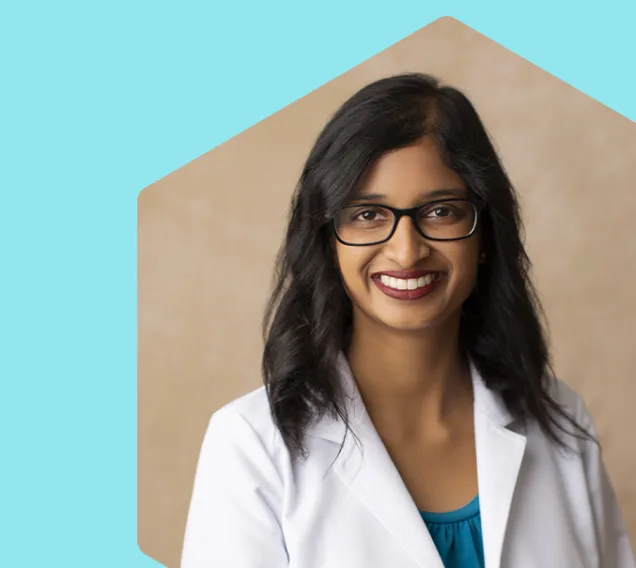
OMA Member Story: Nisha Kuruvadi, DO, DABLM, DABOM
Share this post
Seeing the Person Beyond the Diagnosis
For Nisha Kuruvadi, DO, DABLM, DABOM, moving to San Diego, California meant more than just returning to her hometown; it meant having the opportunity to provide care for the community that raised her.
Today, Dr. Kuruvadi now practices primary care and medical weight management as a triple board-certified physician in internal medicine, obesity medicine, and lifestyle medicine. Her work brings those specialties together to help patients improve their health through compassionate, evidence-based care.
Her approach can be summed up in four words: compassionate, nonjudgmental, evidence-based, and personalized.
At the center of it all is a commitment to seeing each patient as an individual.
“Every patient has a unique story,” she said. “They deserve individualized, compassionate care rooted in science, not judgment.”
Caring for the Whole Person
Healthcare was always part of the conversation in her home.
She grew up in a family of dentists, where discussions about health and medicine were a normal part of everyday life. Although dentistry interested her, she found herself drawn to a broader view of care.
She wanted to understand the full picture of a patient’s health, form long-term relationships, and help people through every stage of their lives.
“I knew I wanted to care for the whole person.”
That interest ultimately led her to internal medicine and primary care, where she could treat a wide range of conditions and build meaningful relationships with patients over time.
As her career progressed, however, she began to realize a significant gap.
Looking Beyond “Eat Less, Move More”
Obesity was familiar to Dr. Kuruvadi long before it became her specialty.
Several members of her family lived with obesity and related conditions, including diabetes, high blood pressure, and high cholesterol. Like many patients, they were often told to eat less and exercise more without receiving the tools, education, or ongoing support they needed.
After completing her internal medicine training, she realized she wanted to understand obesity more deeply. Something was missing from the traditional approach.
“The more I learned, the more I realized that obesity is a complex chronic disease driven by biology, not a lack of willpower,” she said.
That realization led Dr. Kuruvadi to pursue board certification in obesity medicine. It also strengthened her motivation to change the stigma surrounding treatment, especially misconceptions about anti-obesity medications.
She saw that judgment came not only from the public and media, but sometimes from within healthcare itself. She wanted to gain the expertise to offer evidence-based treatment while advocating for patients who deserved more than oversimplified advice.
Seeing What Is Possible
Her connection to obesity medicine became even stronger once she began treating patients. She saw how dramatically life could change when patients finally received appropriate care and support. She saw that weight loss was often only one part of the larger story.
Patients improved their blood pressure, cholesterol, and blood sugar. Some reduced or discontinued medications. Others became more active, regained confidence, and began to enjoy life again.
“The most rewarding part is seeing patients regain their health and confidence,” she said.
Sometimes victories are reflected in laboratory results. Other times, they are revealed in feedback from patients.
A patient may tell her they have more energy, can keep up with their family, or finally feel like themselves again. Those moments continue to reinforce why she chose the field.
Challenging Stigma Through Science
One of the most persistent challenges in obesity care is the belief that patients simply need to “try harder”.
Messages such as “just diet and exercise” ignore the biological, genetic, environmental, and behavioral factors that shape obesity.
Dr. Kuruvadi wants both patients and healthcare professionals to recognize that obesity deserves the same treatment as any other chronic disease.
“We don’t judge someone for needing insulin to treat diabetes or medication to treat depression,” she said. “Obesity deserves that same evidence-based approach.”
That means treatment includes nutrition, physical activity, sleep, stress management, behavioral support, medication, or a combination of strategies tailored to the patient.
It also means recognizing that long-term support is essential. She encourages people living with obesity to seek out clinicians with specialized training who understand the disease and can provide comprehensive care without judgment.
Treating Health from Every Angle
Becoming board-certified in internal medicine, obesity medicine, and lifestyle medicine is one of the accomplishments she is most proud of. Together, the three specialties allow her to approach health from multiple perspectives.
Internal medicine gives her a strong foundation in chronic disease management, while lifestyle medicine supports discussions around nutrition, physical activity, sleep, stress, and prevention. Obesity medicine brings a deeper understanding of the biology of weight regulation and the full range of available treatments. The result is a more complete view of each patient.
Rather than focusing only on their weight, she can address the many factors that influence health and help patients create a treatment plan that fits their lives.
Listening First
For clinicians entering obesity medicine, her advice is simple. As the field continues to evolve rapidly, with new research, therapies, and clinical guidance emerging regularly, Dr. Kuruvadi advises others to “stay curious and never stop learning”.
But knowledge alone is not enough. She believes the most important skill is listening.
Patients often arrive with years of frustration, disappointment, and experiences of weight bias. Understanding that history is essential to developing a treatment plan that feels realistic and supportive.
“Treat obesity with the same compassion and respect you would any other chronic disease,” she said.
Even small changes can make a meaningful difference in a patient’s life, especially when they feel supported rather than judged.
Growing Through Community
The Obesity Medicine Association has played an important role in her professional development.
The OMA’s educational resources help her stay current with research, clinical guidance, and new treatment approaches. She also credits the organization with connecting her to physicians across the country who share her passion for improving obesity care.
As the chair of the OMA’s Communications & Media Committee, Dr. Kuruvadi values the practical education and CME opportunities, but the relationships she has built have been just as important.
“I’ve learned so much from my colleagues and am grateful to be part of such a supportive organization,” she said.
For her, the OMA membership means having a network of clinicians who understand the challenges of the field and are willing to learn from one another.
Making Complex Topics Understandable
Patients and colleagues may be surprised to learn how much she enjoys teaching.
Whether she is speaking at a conference, educating a patient, or creating content for healthcare professionals, she enjoys translating complicated medical information into something practical and understandable.
That ability is especially important in obesity medicine, where patients are often exposed to confusing or conflicting information.
By making the science of obesity medicine more accessible, she hopes to help people feel informed, empowered, and more confident in their healthcare decisions.
Finding Balance at Home
Outside of work, Dr. Kuruvadi recharges by spending time with her family.
She enjoys taking walks, being outdoors, exploring hiking trails, and discovering new places around San Diego. Travel also allows her to experience new environments and spend meaningful time with loved ones.
Those moments help her reset and maintain balance while continuing to bring energy and focus to her patients.
Looking Ahead
As obesity medicine continues to grow, she is grateful to be part of a specialty that is changing how obesity is understood and treated.
The field is moving away from blame and oversimplified advice — and toward science, compassion, and individualized care.
Her patients remain her greatest source of motivation. Their progress inspires her to continue learning, teaching, and advocating for better treatment.
As the OMA celebrates Member Appreciation Month, Dr. Kuruvadi’s story reflects the power of caring for the whole person. By combining evidence-based medicine with empathy and education, she is helping patients improve their health, rebuild their confidence, and see what is possible when care begins without judgment.

Sponsored Ad

Sponsored Ad

Sponsored Ad