
OMA Member Story: Meenal Shukla, MD, DABOM
Share this post
Transforming Personal Challenges into Community Change
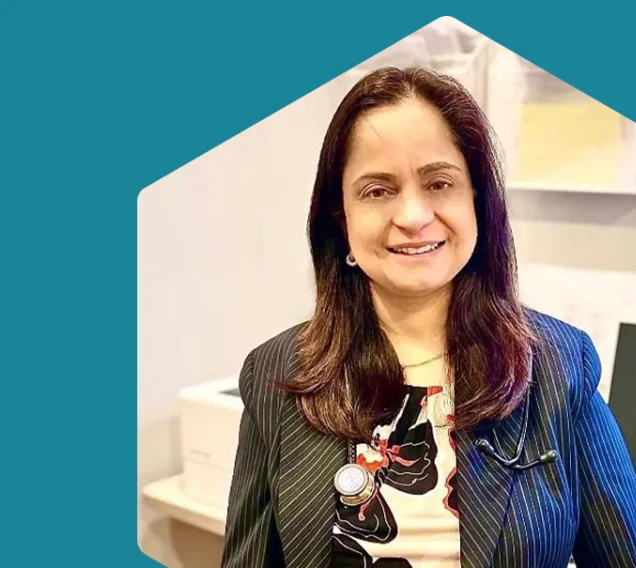
When Meenal Shukla, MD, DABOM, began practicing family medicine in Brooklyn more than two decades ago, she expected to spend her days treating diabetes, hypertension, and other chronic illnesses.
What she didn't expect was that nearly all of these conditions were connected to one thing: obesity.
As she cared for patients in an underserved community, she realized that treating complications wasn't enough. To truly improve health, she needed to address the disease itself. This realization would transform both her practice and her own life.
A Professional Journey with Personal Roots
“My journey with obesity medicine didn’t start with my practice; it started with me.”
After graduating from medical school, Dr. Shukla completed a residency and subspecialty training in obstetrics and gynecology. She soon moved to the United States, where she matched into an internal medicine residency.
“It was very exciting,” she said. “But it was the most challenging period of my life.”
Completing medical school and two residencies back-to-back meant long hours, lengthy commutes, and little time to care for herself. During that period, she was also pregnant.
Healthy meals devolved into whatever she could quickly eat between patients. Often, that meant vending machine snacks or cafeteria food. Sleep was inconsistent, exercise became an afterthought, and she began to gain weight.
"It took a toll on my health, and I started neglecting myself," she admitted.
When she returned to work, she experienced something she hadn't expected: weight bias.
She encountered judgment not only in her professional life but also in her personal life, from colleagues, family members, and others around her.
"Obesity not only affects you externally," she said. "It affects your confidence, self-esteem, and your health."
Those experiences gave her a new understanding of what many of her patients were facing every day.
Finding a New Purpose
When she started caring for patients in Brooklyn, she noticed so many similarities between their stories and her own. Many patients blamed themselves for their weight. Others believed obesity was simply "a family curse" and that nothing could be done to change it.
“In 2012, people didn’t want to talk about their weight,” she said.
At the time, there was little public understanding and information on obesity as a chronic disease.
She searched for answers herself, reading articles, exploring online resources, and following advice from different sources in order to lose weight, but nothing worked. The more she learned, the more convinced she became that both she and her patients deserved better.
"I decided to do something for myself and my community."
That decision led her to pursue board certification in obesity medicine.
Outside Factors Beyond Medicine
After earning her certification, Dr. Shukla was excited to bring her new expertise in obesity medicine to her practice. She launched a weight management program as she finally had the tools to help her patients succeed. But despite her knowledge and enthusiasm, the program struggled.
"Most of the barriers that my community, in particular, faced could not be solved in the exam room," she shared. "They [the barriers] were because of a lack of education on obesity, socioeconomic inequalities, and healthcare disparities."
One of the biggest barriers her patients faced was a lack of access to places to exercise. She realized that recommending physical activity meant little if patients couldn't afford a gym membership or the necessary transportation.
Encouraging healthier eating was equally challenging when grocery stores were scarce, and fresh fruits and vegetables were financially out of reach for her patients.
Building a multidisciplinary team proved to be a challenge, as well.
"It was difficult for me to get a dietitian, physical therapist, and social worker under one roof to get the patient the resources they needed," she said. "Most insurance wouldn’t cover the services.”
The experience fundamentally changed how she approached obesity care.
Building the 365 Days Obesity Challenge
In 2025, Dr. Shukla had the opportunity to put years of knowledge and experience into action.
After receiving a grant through the American College of Physicians' obesity management program, she launched the 365 Days Obesity Challenge of Brooklyn.
The year-long program was designed to help participants achieve sustainable weight loss while providing lifestyle modifications that fit their daily lives.
Its goal is to help patients lose 5-10% of their body weight while providing the education, support, and practical resources needed for long-term success.
Each week, patients participate in sessions led by physicians and physical therapists to develop culturally relevant, affordable nutrition and accessible physical activity plans.
The program also helps to educate patients on obesity as a chronic disease, as well as complications and treatment options.
Recognizing that education doesn't stop in the classroom, they take participants to local markets, host cooking demonstrations, and provide peer support forums where they celebrate successes and discuss challenges.
For Dr. Shukla, the program represents a shift from simply treating obesity to empowering communities with the knowledge and resources needed to manage it.
She hopes to expand the initiative to other underserved communities and eventually internationally.
Changing the Conversation
One message Dr. Shukla hopes more people understand is that obesity deserves the same attention and compassion as any other chronic disease.
She also believes it's important for patients to recognize that effective treatment with lasting success takes time, and setbacks are okay.
“They might fail a few times," she explained. "But if they keep trying, they will be able to lose weight."
For her, every small step forward is evidence that change is possible.
As OMA celebrates Member Appreciation Month, Dr. Shukla's story reminds us that meaningful obesity care extends beyond treatment plans and office visits. By combining personal experience with community-driven solutions, she is helping transform the way obesity is treated in Brooklyn, one patient at a time.